
Governance
Stichting Norma places great importance on a careful, transparent, and integrity-driven governance structure. Governance relates to the functioning of the foundation’s bodies, in particular their mutual relationships, tasks and powers, and the way in which management and supervision are carried out by Norma. For a collective management organisation with a legal or de facto monopoly position, it is crucial to act consciously within the broader societal context, considering the various interests Norma operates in and represents externally. Norma is a non-profit foundation. All resources are used to achieve the statutory objectives and for the benefit of the rightsholders. The supervisory body monitors management costs to ensure that the collected funds benefit rightsholders as much as possible.
Copyright and Neighbouring Rights Collective Management Organizations Control Board
On 15 July 2003, the Supervision of Collective Management Organisations (Copyright and Neighbouring Rights) Act (Supervision Act) entered into force. This Act led to the establishment of the Copyright and Neighbouring Rights Collective Management Organizations Control Board (CvTA). With the implementation of Directive 2014/26/EU, the Supervision Act was amended (26 November 2016). As a result, additional governance requirements now apply to collective management organisations (CMOs). The CvTA is responsible for supervising CMOs. The CvTA ensures that CMOs maintain clear records, collect due remuneration in a lawful manner and distribute it to rightsholders in a timely fashion, apply transparent tariff structures, and are adequately equipped to perform their tasks properly. In carrying out its duties, the CvTA has several powers: the right to advise, the right to information, the right of access, the right of inspection, and the power to issue instructions.
Principles of the Governance Code for CMOs and VOICE
The VOICE Governance Code for CMOs, issued by the industry association VOICE, contains standards for good governance and supervision, an ethical and open organisational culture, transparency towards rightsholders and other stakeholders, careful decision-making, and balanced consideration of interests. This code was drawn up by VOICE, the trade association for collective management organisations. Norma is a member of VOICE and is committed to complying with the Governance Code for CMOs. Norma applies the principles contained therein in its governance practice and ensures that its articles of association, regulations, and internal procedures remain consistent with the Code. In addition, VOICE serves as the point of contact on behalf of CMOs for questions about the collective exercise of copyright and related rights, and acts as a reporting point for complaints and grievances .The managing director of Norma is also a board member of VOICE.
Governance Model
Norma operates a two-tier Supervisory Board model. Day-to-day management is entrusted to the managing director, who operates under the supervision of the Supervisory Board. The Supervisory Board supervises the policy of the managing director, its implementation, and the general affairs of the foundation. In performing their duties, the managing director and the Supervisory Board members are guided by the interests of the foundation. These interests focus on safeguarding continuity and the long-term sustainability of the statutory objectives.
Organogram
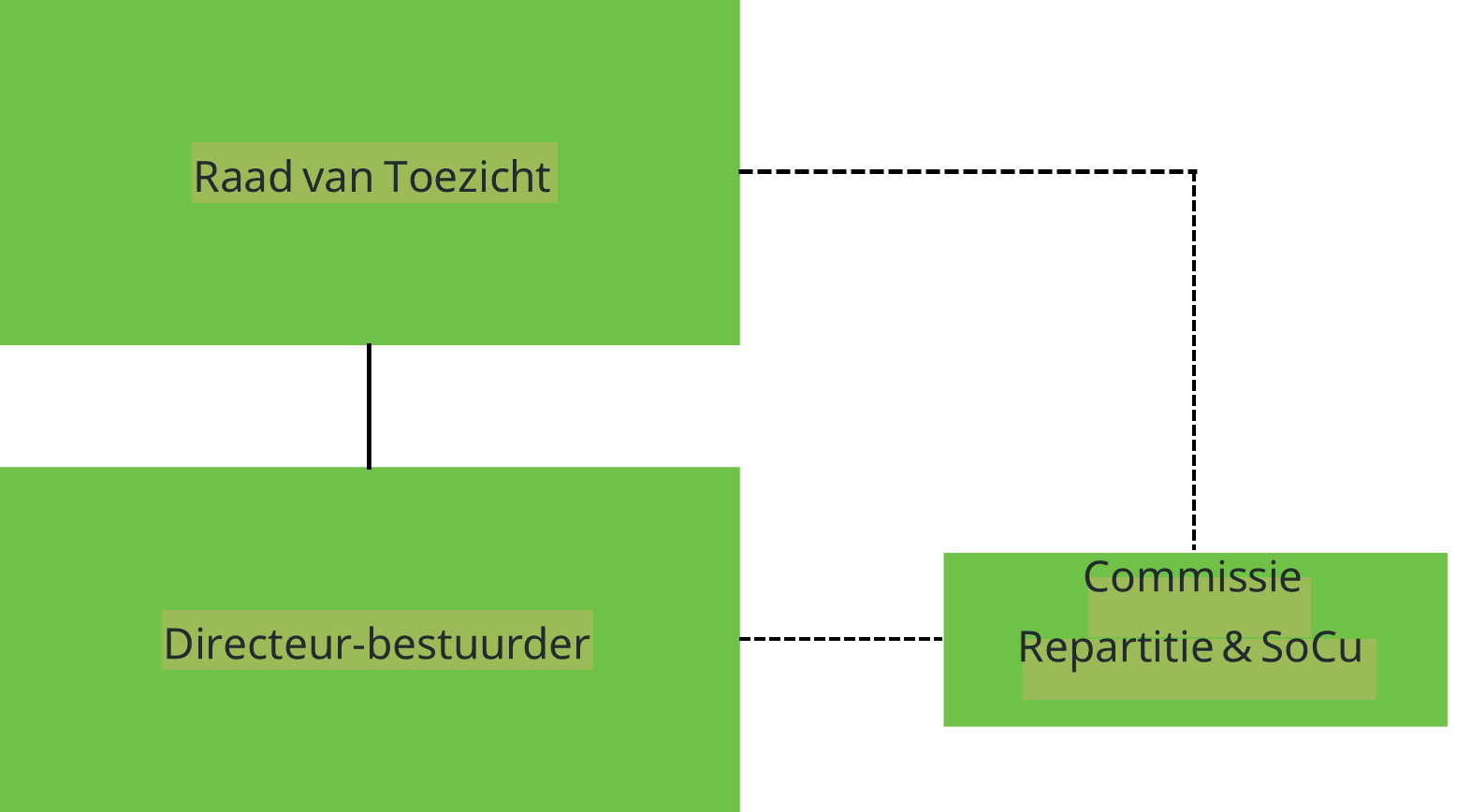
The Distribution & Socio-Cultural Funds Committee and the Meeting of Affiliates
The Distribution & Socio-Cultural Funds Committee consists of and represents rightsholders. The committee advises the Supervisory Board on distribution matters, including distribution regulations. It also advises the managing director on the allocation of socio-cultural funds. The Meeting of Affiliates is the annual meeting where rightsholders are informed and consulted on policy matters.
Fair representation of rightsholders
In accordance with Directive 2014/26/EU and its implementation in the Netherlands through the Supervision Act, rightsholders are involved in Norma’s decision-making in a fair and balanced manner. Although Norma is a foundation and therefore has no membership structure, rightsholders or their representatives can exert influence on policy